
Where to Place a Security Camera in Your Garage?
Place garage cameras for maximum coverage: vehicles, house entry door, overhead door, and tool walls. Learn angles, height, lighting, and other pro tips.
CATEGORIES




Your Garage Isn’t Just for Cars
Published: 06-June-2025
TL;DR

Prioritize four views: cars, interior house door, overhead garage door, and storage/tools. Mount cams high, angle down, add lighting, use activity zones, and pair with door/tilt sensors. Aim for footage that IDs who, what they touched, and where they went.
If you’re like most folks, your garage is part parking lot, part storage unit, part workshop – and usually the easiest path into the house.
That’s exactly why tossing a random camera in the corner isn’t enough. Angle matters. Height matters. What you prioritize matters.
“So where should the camera actually go?”
Short answer: point it at what thieves want and where they’ll come from – your vehicles, the door into the house, and the overhead door. Then cover shelves and tool walls as a bonus.
Here’s how I think about it when I walk a garage with someone: if I were sneaking in, what’s my first move?
Check the car for a clicker. Try the interior door. Grab bikes or power tools near the exit.
Your camera should see each of those moves clearly, with faces (not just hats) and hands (not just silhouettes).
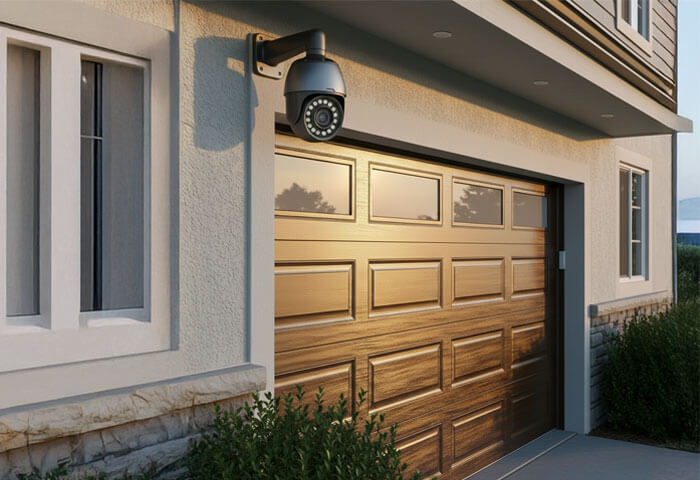
Garage door security camera – AI image
We’ll keep it simple: one camera can often do the job if you mount it smartly; two gives you near-perfect coverage.
Aim for high, slightly downward, avoid glare, and make sure you can tell who did what, not just that “someone” was there.s, starting with the simplest one: manual locks.
Cover the Vehicle First
If someone’s breaking into your garage, the car is often the prize, or the tool.
Thieves will check for a garage door clicker on the visor, a garage door opener left in the console, or keys sitting in plain sight. Catching those moments is huge.
Here’s how I usually set it up:
》Mount high, centered on the driveway side. Aim the camera from above the center of the garage door or from the ceiling near the front.
That gives you a clear, downward view of both vehicles and the area around them. You want faces and hands – not just blurry blobs.
》Angle for the license plate and the driver’s seat. If someone’s rifling through the car, you want the plate and their face in frame. A slightly off-center angle (not dead-on) often captures both better than a straight-on shot.
》Avoid occlusions. Don’t aim where garage shelves, open doors, or bikes will block the view. Do a test recording with the garage staged how you normally leave it: tools, boxes, open car door, etc.
》Consider a second camera for multi-car garages. One camera centered might miss activity behind a second vehicle. If you’ve got two cars parked nose-to-nose or side-by-side, a second camera covering the opposite angle fixes blind spots.
》Lighting matters. Garages are often dim. Use a camera with good low-light performance or add a motion-activated light above the garage entrance. That light will both improve capture quality and act as a deterrent.
Bottom line: your camera should make it easy to tell who reached into the car, what they grabbed, and how they left. If the footage doesn’t answer those questions, move the mount and test again.
Watch the Entry Door Into the House
If I could only cover one spot inside the garage, it’d be this door.
It’s the shortcut from “garage rummaging” to “inside your home,” and a lot of folks leave it with a flimsy knob lock. Your camera should make anyone touching this door unmissable.
Placement that works:
- Mount high, opposite the door, 7–9 ft up, angled down and slightly across the doorway. You want a clean shot of faces as they approach and hands on the handle/lock.
- If the wall opposite is too close, mount on the adjacent wall and angle to catch a 3/4 profile—better for ID than a top-down forehead shot.
Avoid these mistakes:
- Backlighting blowout. If the house light spills through when the door opens, your camera can wash out. Enable WDR/HDR or place a small sconce/light near the garage side of the door to balance exposure.
- Obstructions. Don’t let shelving, a hanging bike, or a tool bench sit between the lens and the door. Keep a clear cone of view.
Settings & gear tips:
- Use a cam with human detection (not just motion) to reduce alerts from dust or insects.
- Pre-roll/buffer (if available) captures a few seconds before motion – useful when someone darts in fast.
- Pair the cam with a chime/notification so you get a ping if that door opens when you’re not expecting it.
Pro move:
Put a door contact sensor on this door, too.
Camera + contact = video of who, and a timeline of when it opened. That combo is gold when you’re reviewing clips.
My take: If your camera misses a clear face at the house door, fix it before you worry about anything else. This is your last line before the living room.
Keep an Eye on the Overhead Garage Door
This is where intruders enter, so give yourself a front-row seat to the action. You want to see the door opening, who’s coming in, and what they do in the first few seconds.
Placement that works:
- High and centered at the back wall, aimed toward the overhead door. Mount at 7–9 ft on the wall or ceiling joist above the workbench area, angled slightly down. You’ll capture the door panels, anyone slipping under, and movement across the whole bay.
- If the back wall is cluttered, mount on a side wall near the rear and angle across the space. A three-quarter angle often gives better face shots than straight-on.
Why this angle matters:
- You’ll catch the moment the door starts to lift (forced entry vs. remote open).
- You’ll see faces as they duck under – not just silhouettes.
- You’ll record direction of travel (straight to the vehicles? the house door? the tool wall?).
Avoid these mistakes:
- Shooting into daylight. If your door has windows or opens to bright sun, your footage can blow out. Turn on WDR/HDR and add a small utility light behind the camera to lift foreground shadows.
- Mounting too low. Chest-level mounts get blocked by hoods, shelves, or a raised trunk. Stay high.
- Pointing at moving parts. Don’t aim so tight that the opener trolley or chain is constantly in frame, triggering motion alerts with every cycle.
Settings & gear tips:
- Choose a camera with good low-light performance (or use a model with an integrated spotlight).
- Enable activity zones across the door opening to reduce false alerts from side clutter.
- If available, use pre-roll/buffer so you capture the instant the bottom seal breaks.
Pro moves:
- Pair the cam with a tilt sensor on the overhead door. When the sensor says “door opened,” you’ll know exactly which clip to review.
- Add a top weather seal and an emergency-release shield; your camera will then document attempted coat-hanger pulls instead of successful ones.
My take: This is your “tripwire” view. If the camera doesn’t clearly show the door going up and a face ducking under, adjust the angle until it does.
Don’t Forget Storage and Tools
Cars get the attention, but thieves love what’s on your walls – bikes, e-bikes, compressors, tool chests, mowers, fishing gear.
If it’s portable and pricey, it’s a target. Your camera should make it painful to grab-and-go.
Placement that works:
- High on the opposite wall, angled down the length of your shelving or pegboard. You want a clean view of hands on hooks and faces at eye level.
- For long walls, consider a wide-angle cam mid-wall, or two cams at each end slightly toed-in so their fields overlap. That kills blind spots behind tall shelves.
What to capture:
- Faces + hands near big-ticket zones: bike racks, tool chests, yard equipment.
- Exit paths: aim so the camera sees how someone leaves (toward the overhead door or side door). Footage that shows the item + the exit is gold.
Lighting = evidence quality:
A dim corner turns a thief into a silhouette. Add a motion puck light under a shelf or a strip light along the joist above the tool wall. Your camera’s sensor will thank you.
Avoid these mistakes:
- Mounting behind clutter. A bike on a repair stand or a hanging ladder will block your lens for weeks. Keep a clear corridor from lens to loot.
- Shooting parallel to shelves only. Angle across the gear, not just along it, so faces aren’t hidden by tool handles.
Pro moves (cheap and effective):
- QR your stuff: Stick QR-coded labels (or etched markings) on big items. If they walk, police can ID them fast.
- Lock + watch: Run a cable lock through bikes or mowers inside the camera’s view. Visible resistance + recording equals “not worth it.”
- Smart zones: Set activity zones on the shelf line and bike rack. You’ll get alerts for grabby hands, not dust or door shadows.
Quick self-check: If someone yoinks your bike, can your current camera angle show which bike, who took it, and how they exited? If not, nudge the mount, add a light, and test again.
Think Like a Thief, Place Like a Pro
Cover the vehicle, the door into the house, the overhead door, and the tool/storage wall.
Mount cameras high (7–9 ft), aim slightly down, avoid glare, add a bit of light, and test with your garage in its real everyday mess.
If your footage clearly shows faces, hands, and exit paths, you’ve nailed it.

Marvin McAlister is an enthusiastic advocate for home safety and security, possessing a solid grasp of the subject through years of personal and professional involvement with security equipment. Check more about Marvin here.

The content of this page is meant exclusively for informational purposes. Conducting a professional safety audit is our recommendation when there is a proven danger.
Categories




Subcategories
Essentials 》guides • case studies
Around the home 》garden • patio • pool • garage • shed • recreational areas • electrical • lighting • animals and pests • fence • sidewalk • mailbox • doorstep
Far from home 》city • village • countryside • wildness
Vehicle safety 》general • passengers • driving • parking
You are in this section
– Safety plans
– Home security
– Fire safety
》Outdoor safety
– Firearm safety
– Family safety
– Disaster preparation