
GFCIs: Outdoor Circuit Protection Basic Guide
Learn why outdoor GFCI outlets are essential. This guide explains how they work, where to install them, and how they keep you safe from shocks.
CATEGORIES




Why Outdoor Electrical Safety Matters More Than You Think
Published: 12-June-2025
TL;DR

GFCIs (Ground Fault Circuit Interrupters) shut power off instantly if electricity leaks where it shouldn’t - like into water, tools, or people.

Outdoors, they’re non-negotiable. Install them at all exterior outlets, test them monthly, and replace old ones without hesitation.
Here’s the thing: outdoors, you’ve got rain, mud, kids with wet hands, and power tools running on long cords.
That’s a recipe for accidents. A GFCI outlet acts like a watchdog.
The second electricity starts flowing where it doesn’t belong, the GFCI cuts power before you even feel more than a tingle.
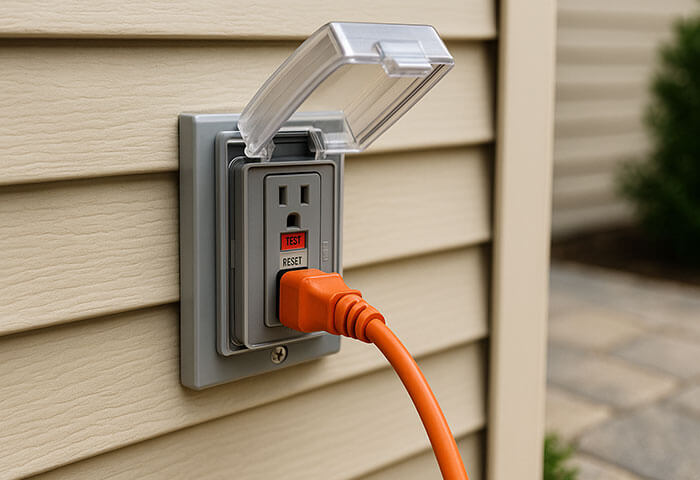
An outdoor GFCI outlet with a weatherproof cover – AI Image
I always tell people: Would you feel safe plugging in your hedge trimmer right after a rain shower?
If the outlet’s GFCI-protected, the answer should be yes.
Without it? That’s gambling.
Outdoor GFCI Safety Checklist
| Step | Action | Why It Matters |
| Install | Use GFCIs on all outdoor outlets | Cuts power instantly in case of fault |
| Cover | Add weatherproof outlet covers | Protects from rain, dirt, and damage |
| Test | Press “Test/Reset” monthly with a lamp | Ensures the GFCI still works fast |
| Replace | Swap every 10 years or if test fails | Old units lose reliability over time |
What a GFCI Actually Does
Let’s break it down simply.
Electricity runs in a loop – hot to neutral. A GFCI measures the current on both wires.
If there’s even a tiny mismatch (as little as 4–6 milliamps), it assumes the missing current is leaking somewhere unsafe – maybe through water, maybe through a person. It reacts in milliseconds by shutting off.
In plain English?
It notices the danger before you do and kills the circuit. That’s why building codes everywhere require GFCIs for outdoor and wet areas.
They’re not just nice to have – they’re life-saving.
Where You Need GFCIs Outdoors
Every outdoor outlet should be GFCI-protected. That means:
- Patio and deck outlets
- Garden outlets (for lights, pumps, tools)
- Garage and shed outlets that connect outside
- Pool and hot tub areas (mandatory)
I’ve seen homes where only the front porch outlet was GFCI. That’s like wearing one glove in a snowstorm – it doesn’t help where you need it most.
My advice? Walk around your property. Every outlet cover you see outside should say “GFCI Protected” or have the little “Test/Reset” buttons. If not, it’s time for an upgrade.
How to Test a GFCI (And Why You Should)
GFCIs don’t last forever. Dirt, moisture, and time wear them down. That’s why you should test monthly.
Here’s the easy way:
- Plug in a lamp.
- Press the “Test” button – the lamp should turn off instantly.
- Press “Reset” – the lamp should turn back on.
If it doesn’t, the outlet’s not doing its job. Replace it.
I make it a habit to check mine at the start of every season. Takes 30 seconds, saves a lot of risk.
When to Replace a GFCI
Even if a GFCI still works, old units lose reliability. The rule of thumb: replace every 10 years, or sooner if they fail tests.
Signs you need a replacement:
- Buttons don’t click firmly.
- Outlet doesn’t reset.
- Test doesn’t cut power.
- Physical damage or discoloration.
I once helped a neighbor who hadn’t replaced theirs in 20+ years. The outlet “looked fine” – until it didn’t trip during testing. That’s not fine.
FAQs
Q: Do I need an electrician to install a GFCI outlet?
If you’re comfortable with wiring and turning off breakers, you can DIY. But if you’re unsure, hire an electrician – safety first.
Q: Are weatherproof covers still needed if I have a GFCI?
Yes. The GFCI protects from shock, but covers protect the outlet from rain and debris. You need both.
Q: Can one GFCI protect multiple outlets?
Yes. If wired correctly, one GFCI can protect outlets downstream on the same circuit.
Q: How often should I test my GFCIs?
Monthly is ideal. At minimum, once per season.
Closing Thought
Outdoors and electricity don’t naturally get along. A GFCI is the peacekeeper – stepping in the second something goes wrong.
Install them everywhere outside, test them often, and replace them before they fail. It’s one of the cheapest, simplest upgrades you can make to keep your family safe.

Marvin McAlister is an enthusiastic advocate for home safety and security, possessing a solid grasp of the subject through years of personal and professional involvement with security equipment. Check more about Marvin here.

The content of this page is meant exclusively for informational purposes. Conducting a professional safety audit is our recommendation when there is a proven danger.
Categories




Subcategories
Essentials 》guides • case studies
Around the home 》garden • patio • pool • garage • shed • recreational areas • electrical • lighting • animals and pests • fence • sidewalk • mailbox • doorstep
Far from home 》city • village • countryside • wildness
Vehicle safety 》general • passengers • driving • parking
You are in this section
– Safety plans
– Home security
– Fire safety
》Outdoor safety
– Firearm safety
– Family safety
– Disaster preparation