
Choosing the Right Extension Cord for Outdoor Projects
Not all cords are equal. Learn how to pick the right outdoor extension cord for tools, lights, and yard projects – safely and easily.
CATEGORIES




Why Outdoor Cords Aren’t the Same as Indoor Ones
Published: 13-June-2025
TL;DR

Outdoor cords need to be heavy-duty, weather-rated, and the right length for your project. Look for “W” (outdoor use), three-prong grounded plugs, and thick gauges for power-hungry tools. Don’t cheap out - a bad cord causes overheating, trips, and even fire.
A plenty of people grab a skinny orange indoor cord, run it out the window, and call it good. It works… until it doesn’t.
Rain, UV light, and rough ground wear those cords out fast.
The insulation cracks, the cord heats up, and suddenly what seemed harmless becomes a fire or shock hazard.
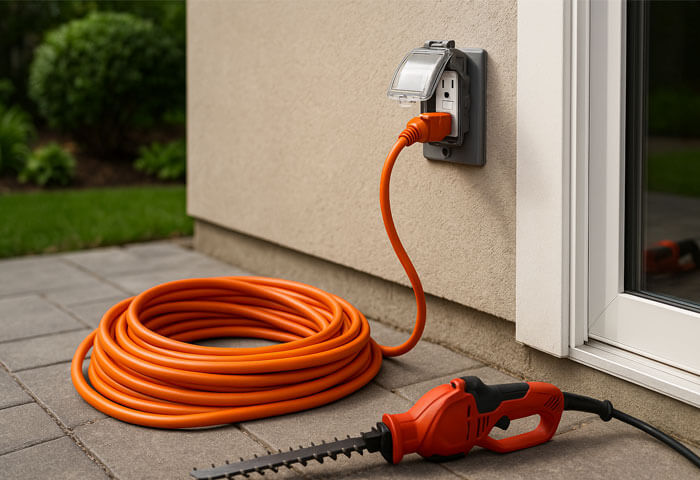
Outdoor extension cord – AI Image
Here’s my rule: if you’re working outside – mowing, trimming, powering a saw, or hanging lights – you need a cord built for the outdoors.
That means weatherproofing, thicker insulation, and the right rating for the job.
Quick Comparison: Outdoor Extension Cords
| Gauge / Length | Best For | Product Suggestion |
| 14-gauge / 25–50 ft | Light tools (trimmers, blowers) | Basics 14/3 Outdoor Cord |
| 12-gauge / 50 ft | Medium tools (saws, pressure washers) | Southwire 12/3 Outdoor Cord |
| 10-gauge / 100 ft | Heavy-duty tools, long runs | US Wire 74100 10/3 Extension Cord |
Tip from experience: if you only want one cord to rule them all, go with the Southwire 12/3. It’s a bit heavier, but it covers 90% of household outdoor projects without breaking a sweat.
Gauge and Power: Matching Cord to Tool
This is where most people get it wrong. The thinner the cord, the less power it can carry. The longer the cord, the more resistance it adds.
Put the two together, and your tool suffers – slow, weak, or overheating.
Here’s what I use:
- 14-gauge cords for light tools like hedge trimmers or leaf blowers.
- 12-gauge cords for bigger gear like circular saws or pressure washers.
- 10-gauge cords if I’m running heavy-duty tools over long distances.
Question I get often: “Can’t I just use one cord for everything?”
Answer: sure, if it’s heavy enough. A 12-gauge cord handles most jobs, but it’s bulkier and heavier than a lighter one.
Length Matters More Than You Think
I once saw someone run a 100-foot cord to power a lawnmower. The mower barely had enough juice, and the cord was hot to the touch.
Why?
Because the longer the cord, the more voltage drops along the way.
My advice:
- Buy the shortest cord that still reaches comfortably.
- For 25–50 ft runs, 14 or 12 gauge usually works.
- For 100 ft, go thicker – 12 or even 10 gauge.
If the tool feels weak or cords are warm, that’s your sign: you need a better cord.
Weather Resistance and Safety Ratings
Look for cords marked with a “W” on the jacket. That’s your guarantee it’s made for outdoor use. Also check for:
- Three-prong grounded plugs – never use two-prong outside.
- Heavy-duty insulation – resists sun, cold, and moisture.
- UL or ETL listing – proves it’s been tested for safety.
I don’t buy cords without those marks. Too many cheap imports look fine but fail fast. Spend a few extra bucks and get one that lasts.
Storing and Caring for Outdoor Cords
Extension cords aren’t cheap, so treat them like tools. Don’t leave them in the rain, don’t coil them tight when they’re hot, and don’t yank them from the wall.
What I do:
- Coil them loosely on a reel or hook.
- Keep them off the ground when not in use.
- Check before each project for cracks or cuts.
I once kept a cord piled in the shed corner. After one season, mice chewed half the insulation. Lesson learned – storage matters.
FAQs
Q: Can I use an indoor cord outside if it’s just temporary?
No. Even one wet night can damage it. Always use outdoor-rated cords.
Q: What gauge should I buy if I only want one cord?
A 12-gauge, 50-foot outdoor cord covers most household and garden projects.
Q: Why does my extension cord get warm?
It’s either too thin for the load, too long, or damaged. Warm cords are unsafe – upgrade or replace them.
Q: Can I plug multiple cords together?
You can, but you shouldn’t. It adds resistance and risk. Buy the right length instead.
Closing Thought
The right cord isn’t just about convenience – it’s about safety. Match the gauge to the tool, keep it short when you can, and buy outdoor-rated every time.
Do that, and your projects run smoother, safer, and without surprises.

Marvin McAlister is an enthusiastic advocate for home safety and security, possessing a solid grasp of the subject through years of personal and professional involvement with security equipment. Check more about Marvin here.
The content of this page is meant exclusively for informational purposes. Conducting a professional safety audit is our recommendation when there is a proven danger.
Categories




Subcategories
Essentials 》guides • case studies
Around the home 》garden • patio • pool • garage • shed • recreational areas • electrical • lighting • animals and pests • fence • sidewalk • mailbox • doorstep
Far from home 》city • village • countryside • wildness
Vehicle safety 》general • passengers • driving • parking
You are in this section
– Safety plans
– Home security
– Fire safety
》Outdoor safety
– Firearm safety
– Family safety
– Disaster preparation